
Common Questions About Lynch Syndrome
Explore answers to frequently asked questions about Lynch Syndrome, including genetics, cancer risks, screening, prevention, family testing, and emerging research.
The information provided here is for educational purposes and should not replace personalized medical advice. Always discuss your individual risks and care plan with a qualified healthcare professional.
What is Lynch Syndrome?
Lynch Syndrome is an inherited genetic condition that increases a person’s risk of developing certain cancers, often at a younger age than expected.
It is caused by a pathogenic variant in one of the genes involved in repairing mistakes in DNA — most commonly MLH1, MSH2, MSH6, PMS2, or EPCAM.
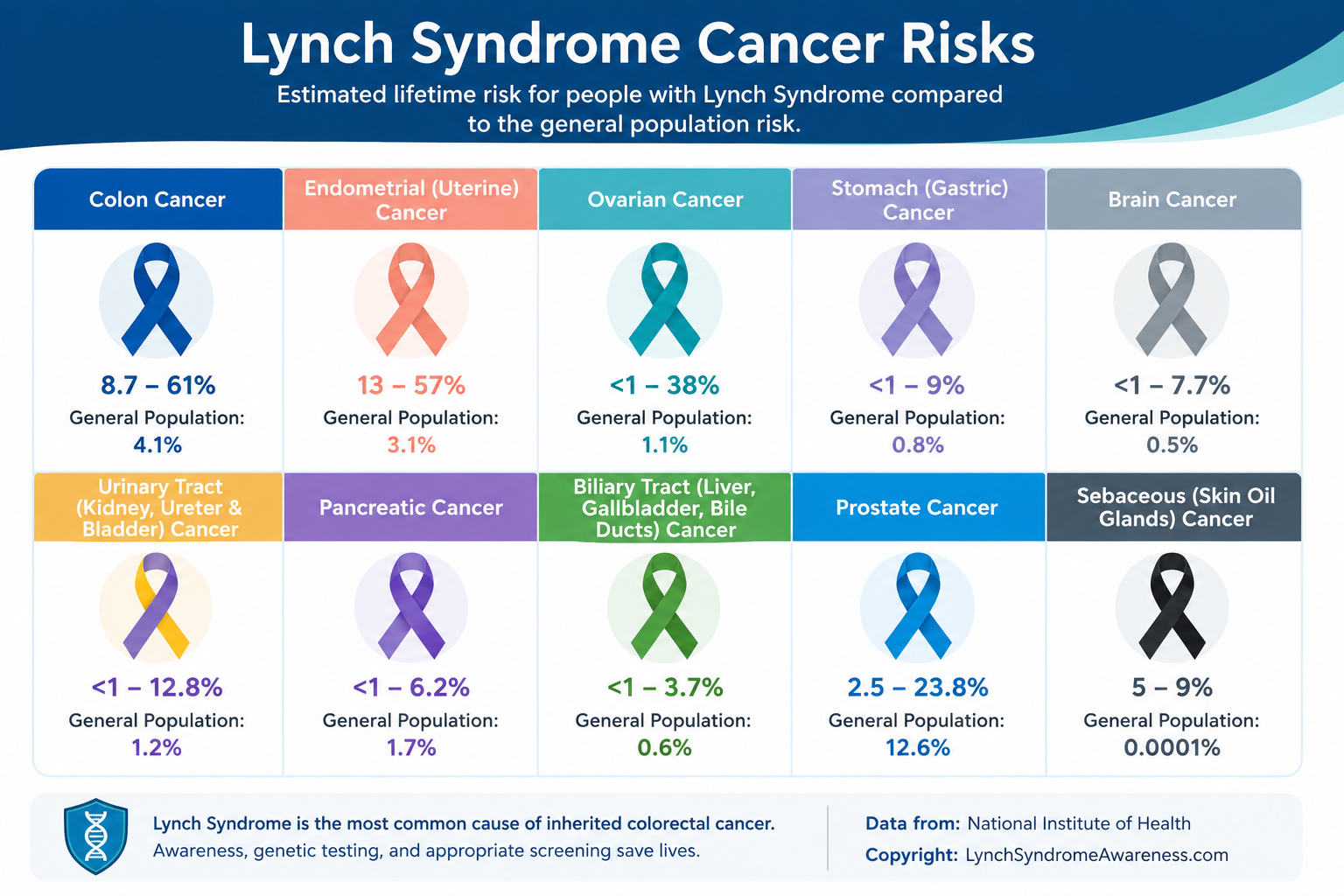
People with Lynch Syndrome have an increased risk of colorectal and endometrial cancers, along with several other cancers, including ovarian, stomach, small bowel, urinary tract, pancreatic, biliary tract, prostate, brain, and certain skin cancers.
Lynch Syndrome was historically known as Hereditary Nonpolyposis Colorectal Cancer (HNPCC), but the term Lynch Syndrome is now preferred because the condition can affect many different organs.
Having Lynch Syndrome does not mean a person will definitely develop cancer, but knowing about the condition allows for earlier screening, prevention, and risk-reducing care.
I think I may have Lynch Syndrome. What should I do?
If you are concerned that you may have Lynch Syndrome, the next step is to speak with a healthcare professional who is familiar with hereditary cancer risk.
- Review your personal and family history.
Tell your doctor or genetic counselor about cancers in your family, including the type of cancer and the age at diagnosis. Lynch Syndrome can sometimes be present even when the family history is not obvious. - Consider genetic counseling and testing.
A genetic counselor can help determine whether genetic testing is appropriate and explain what the results may mean. Testing is usually performed using a blood or saliva sample and may include the Lynch Syndrome-associated genes MLH1, MSH2, MSH6, PMS2, and EPCAM. - Understand what the results mean.
A positive result means that a pathogenic variant associated with Lynch Syndrome was identified. Your healthcare team can then help create a personalized screening and prevention plan, and family members may be offered cascade testing.
A negative result can mean different things. If a known Lynch Syndrome variant has already been identified in your family and you test negative for that specific variant, you generally did not inherit that familial variant. If no familial variant is known, a negative test may not completely explain a strong personal or family history of cancer.
- Ask whether tumor testing is relevant.
For individuals who have had colorectal, endometrial, or certain other cancers, tumor testing such as MMR immunohistochemistry or MSI testing may help identify whether Lynch Syndrome should be investigated further.
How is Lynch Syndrome diagnosed?
Lynch Syndrome is diagnosed through genetic testing that identifies a pathogenic (disease-causing) variant associated with the condition. Testing is most commonly performed using a blood or saliva sample.
Genetic testing typically evaluates the Lynch Syndrome-associated genes MLH1, MSH2, MSH6, PMS2, and EPCAM.
Testing may be recommended based on personal or family cancer history, tumor testing results, or other clinical factors. Increasingly, genetic testing is also identifying people with Lynch Syndrome who do not have a strong or previously recognized family history.
If a Lynch Syndrome variant has already been identified in a family, relatives can undergo targeted genetic testing for that specific familial variant, known as cascade testing.
Genetic counseling can help individuals understand their test results, cancer risks, screening recommendations, and what the results may mean for other family members.
What are the cancers associated with Lynch Syndrome?
People with Lynch Syndrome have an increased risk of developing several types of cancer. The level of risk can vary depending on the specific Lynch Syndrome gene involved — MLH1, MSH2, MSH6, PMS2, or EPCAM.
Lynch-associated cancers may include:
Colorectal, endometrial, ovarian, stomach, small bowel, urinary tract, pancreatic, biliary tract, prostate, brain, and certain skin cancers.
Not every person with Lynch Syndrome will develop cancer, and not every Lynch gene carries the same level of risk for each cancer type.
What are the types of mutations associated with Lynch Syndrome?
Lynch Syndrome is caused by an inherited change in a gene that normally helps repair mistakes in DNA.
The genes most commonly associated with Lynch Syndrome are MLH1, MSH2, MSH6, and PMS2.
Changes involving EPCAM can also cause Lynch Syndrome because they can interfere with the nearby MSH2 gene.
So, when people talk about the “five Lynch Syndrome genes,” they are usually referring to:
MLH1, MSH2, MSH6, PMS2, and EPCAM.
If I am diagnosed with Lynch Syndrome, are my children and family at risk?
What screenings are recommended for patients with Lynch Syndrome?
What screenings are recommended for people with Lynch Syndrome?
Screening and risk-reduction recommendations for Lynch Syndrome are individualized based on the specific gene involved (MLH1, MSH2, MSH6, PMS2 or EPCAM), age, sex, personal cancer history and family history. Recommendations continue to evolve, so individuals should develop a surveillance plan with a healthcare provider experienced in Lynch Syndrome.
Common surveillance recommendations may include:
Colorectal: High-quality colonoscopy at regular intervals. Current recommendations are gene-specific, with MLH1, MSH2 and EPCAM generally beginning earlier than MSH6 and PMS2.
Endometrial & Ovarian: Education about symptoms is important. Endometrial biopsy may be considered every 1–2 years for individuals who have a uterus, although screening has not been proven to reduce endometrial-cancer mortality. Risk-reducing surgery may also be discussed when appropriate.
Stomach & Upper GI: Upper endoscopy (EGD), including evaluation for H. pylori, may be recommended based on the individual's gene, family history and other risk factors.
Urinary Tract: Urinalysis or other urinary surveillance may be considered for selected individuals, particularly when there is a family history of urothelial cancer.
Pancreas: For certain Lynch Syndrome carriers with a family history of pancreatic cancer, annual screening with MRI/MRCP and/or endoscopic ultrasound may be considered.
Skin: Regular skin examinations should be discussed, particularly because Lynch Syndrome can be associated with sebaceous tumors and other characteristic skin lesions.
Other Cancer Risks: Screening recommendations may also be influenced by an individual's gene and family history. Routine age-appropriate cancer screening should continue in addition to Lynch-specific surveillance.
Because Lynch Syndrome cancer risks vary significantly by gene and family history, there is no single screening schedule that is appropriate for every Lynch Syndrome carrier.
https://lynchsyndromeawareness.com/nccn-guidelines/?utm_source=chatgpt.comh
Does having Lynch Syndrome mean that I will definitely get cancer?
No. Having Lynch Syndrome does not mean you will definitely develop cancer. It means you have an increased lifetime risk for certain cancers compared with the general population.
The level of risk varies depending on the specific Lynch Syndrome gene involved — MLH1, MSH2, MSH6, PMS2, or EPCAM — as well as sex, age, personal history, and family history.
Some people with Lynch Syndrome may never develop cancer, while others may develop one or more Lynch-associated cancers during their lifetime.
The good news is that knowing you have Lynch Syndrome allows you to take proactive steps through regular surveillance, risk-reducing strategies, and early detection, which can greatly improve outcomes.
Knowing your gene-specific risk is one of the most important steps in creating the right screening and prevention plan for you.
Is there a CURE for Lynch Syndrome?
Currently, there is no cure for Lynch Syndrome. Lynch Syndrome is an inherited genetic condition caused by a pathogenic variant in one of the DNA mismatch repair genes. The genetic change itself cannot currently be eliminated, but knowing you have Lynch Syndrome provides an important opportunity to prevent certain cancers or detect them at their earliest, most treatable stages.
Management may include:
1. Personalized Cancer Surveillance:
Regular screening—particularly high-quality colonoscopy—is one of the most important tools for people with Lynch Syndrome. Screening recommendations vary based on the specific Lynch gene, age, personal history and family history.
2. Aspirin for Cancer Prevention:
Long-term results from the CAPP2 trial demonstrated that aspirin can reduce colorectal cancer risk in people with Lynch Syndrome. CAPP3 has provided important new evidence about using lower doses of aspirin for prevention. Aspirin is not appropriate for everyone, so the decision and dose should be discussed with a healthcare provider.
3. Risk-Reducing Surgery:
Some individuals may consider preventive surgery based on their gene, age, cancer risks and personal circumstances. For example, hysterectomy and removal of the fallopian tubes and ovaries may be considered for certain women with Lynch Syndrome after childbearing is complete.
4. Emerging Cancer-Prevention Strategies:
Researchers are working toward preventing Lynch-associated cancers before they develop. Investigational approaches include NOUS-209, Tri-Ad5 and mRNA-based preventive vaccines, along with other strategies designed to help the immune system recognize and eliminate precancerous cells.
5. Genetic Counseling & Cascade Testing:
Because Lynch Syndrome is inherited, identifying one carrier can help protect an entire family. First-degree relatives generally have a 50% chance of inheriting the familial Lynch Syndrome variant, making genetic counseling and cascade testing especially important.
The goal of Lynch Syndrome care is increasingly moving beyond early cancer detection toward cancer prevention. Although we cannot yet cure the inherited condition itself, advances in surveillance, prevention and research are creating more opportunities for people with Lynch Syndrome to take proactive control of their cancer risk.
What are the latest advances for Lynch Syndrome?
Recent research has led to significant advancements in the understanding and management of Lynch syndrome, a genetic condition that heightens the risk of various cancers. Notable developments include:
-
Immunotherapy has transformed the treatment of many Lynch Syndrome-associated cancers, particularly tumors that are mismatch repair-deficient (dMMR) or microsatellite instability-high (MSI-H). Researchers are now investigating whether the immune system can also be harnessed earlier—before cancer develops—as a form of cancer interception or immunoprevention.
Preclinical research has shown that immune checkpoint inhibitors can delay tumor development in Lynch Syndrome mouse models, but these drugs are not currently recommended as routine preventive therapy for cancer-free Lynch Syndrome carriers.
Much of the most exciting prevention research is now focused on vaccines and other immune-based approaches, including NOUS-209, Tri-Ad5 and additional investigational vaccines designed to recognize abnormal cells before they progress to invasive cancer. NOUS-209, for example, produced vaccine-specific immune responses in all evaluable participants in its early Lynch Syndrome trial, with responses still detectable at one year in most participants.
-
Asprin as a preventive Strategy.
CAPP2 established aspirin as an important cancer-prevention strategy for people with Lynch Syndrome. In the CAPP2 randomized trial, participants received 600 mg of aspirin daily. Long-term follow-up showed a significant reduction in colorectal cancer among participants who took aspirin for at least two years, with the protective effect becoming apparent several years after treatment began.
CAPP3 was designed to answer the next major question: how much aspirin is actually needed? The international study compared different daily aspirin doses to determine whether a lower dose could provide similar cancer protection with fewer side effects.
The first CAPP3 results, reported in 2026, are encouraging. Investigators reported that 75 mg of aspirin provided protection comparable to the 600 mg dose used in CAPP2, with fewer side effects. Based on the emerging findings, the UK Cancer Genetics Group supports daily low-dose aspirin for people with Lynch Syndrome. Investigators currently recommend 75 mg daily in the UK, with 150 mg considered for people with a BMI over 30, while longer-term follow-up continues.
Researchers are continuing to follow CAPP3 participants for at least 10 years to strengthen the evidence, better understand the relationship between body weight and aspirin dose, and determine how long protection persists.
Important: Aspirin is not appropriate for everyone. Lynch Syndrome carriers should discuss aspirin with their physician before starting it, particularly because age, gastrointestinal bleeding risk, ulcers, H. pylori infection, blood pressure, other medications and individual health history can influence whether aspirin is appropriate and what dose should be used.
3. Cancer Prevention Vaccines: A Promising New Frontier
Researchers are developing vaccines designed to train the immune system to recognize and eliminate abnormal cells associated with Lynch Syndrome before they progress to cancer. Several important approaches are now being studied:
NOUS-209: This investigational vaccine targets 209 shared frameshift neoantigens that can arise in mismatch repair-deficient cells. A Phase 1b/2 prevention study in Lynch Syndrome carriers demonstrated strong and durable immune responses, and the program continues to be studied as a potential strategy for preventing Lynch-associated cancers. In 2026, NOUS-209 received FDA Fast Track designation for the prevention of Lynch Syndrome-associated cancers.
Tri-Ad5: This investigational vaccine targets three tumor-associated antigens—CEA, MUC1 and brachyury (TBXT)—and is being studied in combination with the immune-stimulating agent N-803. The Phase IIb study is evaluating whether this approach can generate protective immune responses and potentially reduce the development of colorectal and other Lynch-associated cancers. The trial is currently active but not recruiting.
INTERCEPT-Lynch / mRNA-4194: The University of Oxford and Moderna are testing a new mRNA-based preventive cancer vaccine specifically for people with Lynch Syndrome. The vaccine is designed to train the immune system to recognize early precancerous changes associated with Lynch Syndrome. The Phase 1 trial received regulatory authorization in 2026, and the first participant received the vaccine in August 2026.
These advancements offer hope for improved prevention and management strategies for individuals affected by Lynch syndrome.

How Lynch Syndrome Affects DNA Repair
Mismatch repair (MMR) genes help protect our DNA by correcting small errors that occur when cells copy their DNA. Normally, this repair system fixes these mistakes before they can accumulate and contribute to cancer.
In Lynch Syndrome, a person inherits a harmful change in one of the genes involved in the mismatch repair system — most commonly MLH1, MSH2, MSH6, PMS2, or EPCAM. When the remaining working copy of that gene is lost or damaged in a cell, the mismatch repair system may stop functioning properly.
This can lead to a buildup of DNA errors, often resulting in mismatch repair deficiency (dMMR) and microsatellite instability (MSI). Over time, these changes can increase the risk of developing certain cancers.


This website is intended for informational purposes only and is not a substitute for professional medical advice, diagnosis or treatment. Please talk to your healthcare provider about any questions or concerns you may have regarding your health.